Press To PlayPaul McCartneyby Patrick Humphries
Article from Sound On Sound, October 1986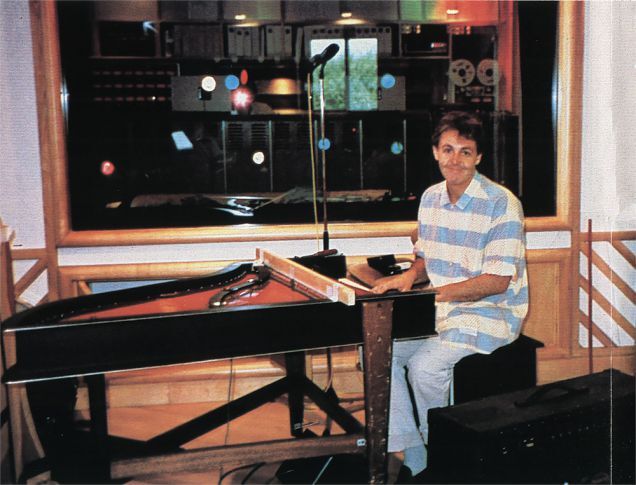 TRACK BY TRACK
 On then to the songs which constitute
Press To Play, with Paul's track by track comments:
ANGRY: "That's me being pretty straightforward, although there is a crazy synth thing on there. The backing track is me, Phil Collins and Pete Townshend, which is a nice little rhythm section! That took maybe two hours to record, while the actual take was around 20 minutes long. They're just so good those guys - you just tell Phil 'It's a fast one, and it stops here!'...
What makes me angry are things like Thatcher's attitude to the blacks in South Africa, and Reagan calling it South
America. People who burn children with cigarettes. That sort of thing makes me angry - not bad reviews of my albums."
TALK MORE TALK: "The basic track was done in a day. Lyrically it was picking out quotes that I liked from, I think, a Tom Waits interview. 'I don't actually like sitting down music', great things like that, random cut-outs. 'A master can highlight the phrases his words to digress'. I liked the surrealism of that line. I like 'art' films, Bunuel, Bergman, 'The Seventh Seal'. I could never make out what the hell they were about, but there was something attractive about the abstractness of them. So I've gone that way on 'Talk More Talk' and 'However Absurd', which are the two main surrealist lyrics."
HOWEVER ABSURD: "It did suggest the epic finale - which is why it's at the end of the album! For me, it was another thing you start off and think 'Ooh no, that's too Beatley, so I won't do it'. So I resisted it for a while, but I kept coming back to 'Why? Tell me one good reason why you're resisting this Beatles influence?' Cos if anyone's got a
right to do it, there's three guys alive who've got the right to do it. I've got past the point of comparisons with The Beatles, or being accused of being a 'Beatle Stylist', but I mean, I
was involved in all that stuff very heavily, and realising it was a good system then, why ignore it now?There's a sort of 'Walrus' intro to this track, but of course any time you play that style on piano it evokes that. It's a style I know and love. The lyrics on this song are a bit bizarre, but then again they make a kind of sense, a strange kind of sense. But then I find that things in life don't always make sense, they're not always conveniently wrapped up with a little sticker that says 'This is very sensible!' Sometimes they are completely absurd, which is what the song is about. In the middle section it explains itself a bit, less surrealist: 'Something special between us... Words wouldn't get my feelings through... However absurd it may seem.' That's taking off into 'The Prophet' by Kahlil Gibran - there's a line of his that always used to attract me and John, which was 'Half of what I say is meaningless, but I say it just to reach you'. So it's that kind of meaning to 'However Absurd'."
MOVE OVER BUSKER: "That's got a good American rock 'n' roll feel to it. I think originally it was called 'Move Over Buster', which Eric and I thought was a bit ordinary. So we just kicked it about a little bit and it came out 'busker', then that gave us more possibilities about wandering round and meeting people...
There's a bit of harmless sexism in the lyrics - that strong British tradition, you know, of seaside postcards. Nell Gwynne, well you know the archetypal image of her, with her oranges and all! Then there's Mae West 'in her sweaty vest' - that's an old Beatle joke 'and here's Miranda in her little sweaty vest'; just one of those insanities. Then we get Errol Flynn, looking out of his motor home, another one who was supposedly renowned for his sexual prowess."
TALK MORE TALK: "The basic track was done in a day. Lyrically it was picking out quotes that I liked from, I think, a Tom Waits interview. 'I don't actually like sitting down music', great things like that, random cut-outs. 'A master can highlight the phrases his words to digress'. I liked the surrealism of that line. I like 'art' films, Bunuel, Bergman, 'The Seventh Seal'. I could never make out what the hell they were about, but there was something attractive about the abstractness of them. So I've gone that way on 'Talk More Talk' and 'However Absurd', which are the two main surrealist lyrics."
HOWEVER ABSURD: "It did suggest the epic finale - which is why it's at the end of the album! For me, it was another thing you start off and think 'Ooh no, that's too Beatley, so I won't do it'. So I resisted it for a while, but I kept coming back to 'Why? Tell me one good reason why you're resisting this Beatles influence?' Cos if anyone's got a
right to do it, there's three guys alive who've got the right to do it. I've got past the point of comparisons with The Beatles, or being accused of being a 'Beatle Stylist', but I mean, I
was involved in all that stuff very heavily, and realising it was a good system then, why ignore it now?There's a sort of 'Walrus' intro to this track, but of course any time you play that style on piano it evokes that. It's a style I know and love. The lyrics on this song are a bit bizarre, but then again they make a kind of sense, a strange kind of sense. But then I find that things in life don't always make sense, they're not always conveniently wrapped up with a little sticker that says 'This is very sensible!' Sometimes they are completely absurd, which is what the song is about. In the middle section it explains itself a bit, less surrealist: 'Something special between us... Words wouldn't get my feelings through... However absurd it may seem.' That's taking off into 'The Prophet' by Kahlil Gibran - there's a line of his that always used to attract me and John, which was 'Half of what I say is meaningless, but I say it just to reach you'. So it's that kind of meaning to 'However Absurd'."
MOVE OVER BUSKER: "That's got a good American rock 'n' roll feel to it. I think originally it was called 'Move Over Buster', which Eric and I thought was a bit ordinary. So we just kicked it about a little bit and it came out 'busker', then that gave us more possibilities about wandering round and meeting people...There's a bit of harmless sexism in the lyrics - that strong British tradition, you know, of seaside postcards. Nell Gwynne, well you know the archetypal image of her, with her oranges and all! Then there's Mae West 'in her sweaty vest' - that's an old Beatle joke 'and here's Miranda in her little sweaty vest'; just one of those insanities. Then we get Errol Flynn, looking out of his motor home, another one who was supposedly renowned for his sexual prowess
PRETTY LITTLE HEAD: "That was done very quickly, without thinking too much about it. I had a new studio, a new producer, a new songwriting partner, so I wanted to try something different. We'd push it a bit further just to see what would happen. That was an old philosophy of The Beatles - particularly on things like 'Sergeant Pepper' - you'd just start off with a backwards track, something zany, then you'd make up something from what it suggested. It's quite a nice way of working - a bit like abstract art...For a long while 'Pretty Little Head' was an instrumental. I drummed on it, Jerry Marotta played vibes, and Eric Stewart played keyboards, so we all switched roles to send us off in a different direction. Eventually you pull it back and make some sort of sense of it.Again, the lyrics on this one are pretty exotic. I see it as a tribe who live in the hills who descend from their caves once every blue moon to bring silks and precious stones, so that their princess doesn't have to worry her pretty little head. What's kinda nice is that it can also be an ordinary family, and the pretty little head is the kid. The father protecting his family so that you won't have to worry your pretty little head."
ONLY LOVE REMAINS: "People ask if I feel an album's incomplete without a ballad, and I do think that a little bit. I know there are people who like them who will inevitably gravitate towards that particular track... People who've heard the album say 'That's the McCartney I like'. So I sorta put it on for them, and for myself, because I'm pretty romantic by nature. It's not so much the feeling 'Now we must do the compulsory ballad', it's more that I can write them, and I like them. I like the quiet moment, and this song is that reflective moment - and it comes at the end of Side One, so if you're not in that mood, you can always take it off!"
GOOD TIMES COMING / FEEL THE SUN: "There's a nostalgic air about hot summers that have gone. It's a pretty strong feeling, even for people who are only 17, they can remember a summer when they were 10. In Britain you tend not to get too much of that stuff anyway, so you tend to remember 'em.To me the song is three summers: one when I was a kid going to Butlins in my short trousers, feeling embarrassed cos I wanted long trousers. That was a good one, sort of donkeys on the beach summer
Then the second verse is a bit more grown up, when I imagine you're working, so I associate that lyric with The Beatles - 'It was a silly season, was it the best? We didn't need a reason, just a rest!' That's one of my favourite lines on the album. It reminded me of The Beatles because of some photos taken by Dezo Hoffman, great shots of us in old-fashioned Victorian bathing gear, John doing the Charleston - classic stuff.Then the third verse is kinda ominous, talking about a great summer before the war; that takes the good-time edge off it. I remember I heard there were a couple of really cracking summers in 1936 and 1937, or whenever, but Hitler was just round the corner. I always imagined people playing a great game of cricket, in their whites, everything as it should be: gentle applause, tea... and then the next year they're all gonna be off at war. That's the twist in the tail of that song
FOOTPRINTS "From summer to winter. The song was written on a snowy day. It came from an image of a magpie looking for food out in the snow. Eric and I changed the magpie to an old man, although the magpie came back for the third verse. The old man is out there looking for Yule logs or something, like the character in Good King Wenceslas. He's lonely. Does he live on his own? What do we know about him? The song goes into what his story might have been, the heartaches there might have been, the girl he might have left behind, the paths he didn't take, the moves he didn't make, etcetera."
PRESS: "'Oklahoma was never like this'. That can mean whatever you want it to mean. To me, when you're writing songs, you often get a line you assume you're going to edit later, you're going to knock it out and put something sensible in. But every time I came to that line, I couldn't sing anything else - just the scanning, the way it sang. People would have understood it if it was 'Liverpool was never like this', but it wouldn't have sung the same. It's a symbol for the provinces, the sticks, the out of the way places. The line just wouldn't change, and when you meet such resistance from the lyrics themselves, you have to give in."


 ...oui ça en revanche je l'avais lu quelque part. D'ailleurs je n'imaginais pas la séance d'enregistrement comme il la présente. Morceau assez étonnant d'ailleurs, un style qu'il n'a jamais vraiment réédité après, c'est un peu un cas à part dans sa carrière. On sent la volonté de tenter du nouveau, mais...il lui manque une étincelle pour décoller (ça ne décolle pas en fait) un petit quelque chose pour "réussir". Je me souviens de ma déception à la découverte de l'album (par ce morceau...). Il y a une honneteté, un coté direct plaisant, et ce n'est pas du tout indigne. Mais bon, après les ouvertures des albums précedents (Coming up, Yug of War, Pipes of Peace...), là on descend une marche c'est incontestable.